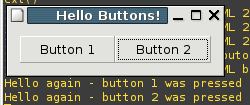
// gcc b0.c -o b0 `pkg-config --cflags --libs gtk+-2.0`

#include <gtk/gtk.h>

/* Our new improved callback.  The data passed to this function
 * is printed to stdout. */
static void callback( GtkWidget *widget, gpointer data)
{
    g_print ("Hello again - %s was pressed\n", (gchar *) data);
}

/* another callback */
static gboolean delete_event(GtkWidget *widget,GdkEvent *event, gpointer data)
{
    gtk_main_quit ();
    return FALSE;
}

int main( int argc, char *argv[] )
{
    /* GtkWidget is the storage type for widgets */
    GtkWidget *window;
    GtkWidget *button;
    GtkWidget *box1;

    /* This is called in all GTK applications. Arguments are parsed
     * from the command line and are returned to the application. */
    gtk_init (&argc, &argv);

/* Create a new window */
    window = gtk_window_new (GTK_WINDOW_TOPLEVEL);
    /* This is a new call, which just sets the title of our
     * new window to "Hello Buttons!" */
    gtk_window_set_title (GTK_WINDOW (window), "Hello Buttons!");
    /* Here we just set a handler for delete_event that immediately exits GTK. */
    g_signal_connect (G_OBJECT (window), "delete_event",
		      G_CALLBACK (delete_event), NULL);
    /* Sets the border width of the window. */
    gtk_container_set_border_width (GTK_CONTAINER (window), 10);
    /* We create a box to pack widgets into.  This is described in detail
     * in the "packing" section. The box is not really visible, it
     * is just used as a tool to arrange widgets. */
    box1 = gtk_hbox_new (FALSE, 0);
    /* Put the box into the main window. */
    gtk_container_add (GTK_CONTAINER (window), box1);

/* Creates a new button with the label "Button 1". */
    button = gtk_button_new_with_label ("Button 1");
    /* Now when the button is clicked, we call the "callback" function
     * with a pointer to "button 1" as its argument */
    g_signal_connect (G_OBJECT (button), "clicked",
		      G_CALLBACK (callback), (gpointer) "button 1");
    /* Instead of gtk_container_add, we pack this button into the invisible
     * box, which has been packed into the window. */
    gtk_box_pack_start (GTK_BOX(box1), button, TRUE, TRUE, 0);
    /* Always remember this step, this tells GTK that our preparation for
     * this button is complete, and it can now be displayed. */
    gtk_widget_show (button);

/* Do these same steps again to create a second button */
    button = gtk_button_new_with_label ("Button 2");
    /* Call the same callback function with a different argument,
     * passing a pointer to "button 2" instead. */
    g_signal_connect (G_OBJECT (button), "clicked",
		      G_CALLBACK (callback), (gpointer) "button 2");
    gtk_box_pack_start(GTK_BOX (box1), button, TRUE, TRUE, 0);

    /* The order in which we show the buttons is not really important, but I
     * recommend showing the window last, so it all pops up at once. */
    gtk_widget_show (button);
    gtk_widget_show (box1);
    gtk_widget_show (window);
    /* Rest in gtk_main and wait for the fun to begin! */
    gtk_main ();

    return 0;
}